- Period
- 13th century; around 1900
- Distance
- 5 min from the Rynek
Wyspiański’s glass at the Franciscan Basilica
A medieval church, badly damaged by fire, took on a new artistic skin around 1900: Wyspiański’s windows and plant-filled wall paintings sit beside work by Mehoffer.
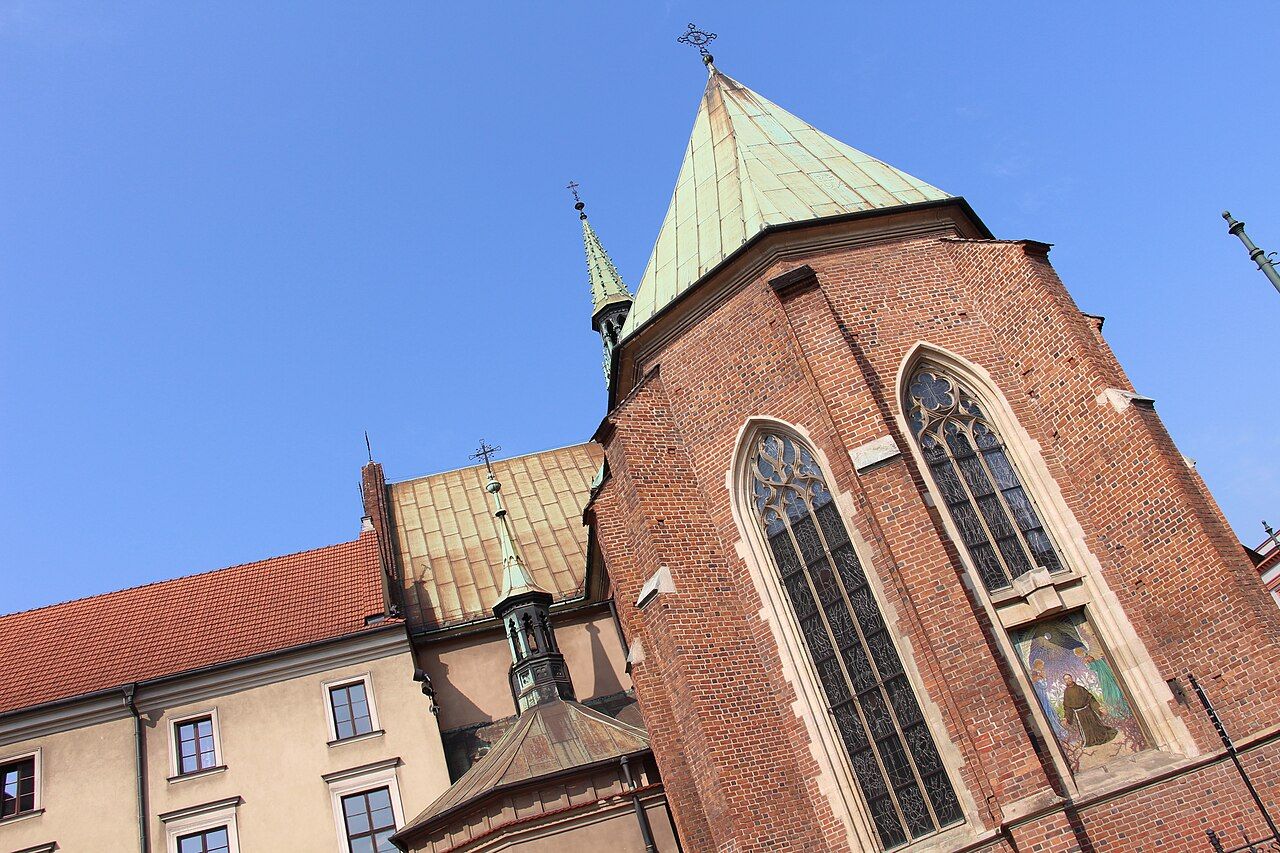
The Franciscan friars came to Kraków in 1237 and built their church just south-west of the Rynek. The Franciscan Basilica is dedicated to St Francis of Assisi. Its story has a medieval beginning, but the art that gives the church its particular face belongs to a later moment.
Myth: is everything here medieval?
The church can seem to belong entirely to its first chapter. Yet the basilica was badly damaged in the great fire of Kraków in 1850, and its art carries another date: around 1900. Stanisław Wyspiański painted the Art Nouveau wall decoration of the chancel and transept in the late 1890s. The old church, then, is not a single period held still. It has a new skin, laid over an earlier story.
I find that contrast easiest to follow through the details. Wyspiański’s wall paintings use lilies, pansies and nasturtiums. Their plant forms make the walls part of the same artistic world as the windows, though painting and glass ask the eye to meet them differently.
The plant names give this decoration a vocabulary drawn from flowers. I find myself moving in thought between the chancel and transept, because Wyspiański’s work belongs to both spaces rather than to one isolated image. The basilica’s later skin is made of painted surfaces as well as glass.
Myth: is Wyspiański’s work only in the windows?
The great west window is the work many people may have in mind: God the Father – Let It Be, designed by Wyspiański and installed in 1904. But his contribution is not confined to that single window. He also designed stained-glass windows in the chancel showing St Francis and Blessed Salomea. And beyond glass, the chancel and transept carry his painted decoration.
The name God the Father – Let It Be gives the large west window a presence in words, as well as in glass. The windows in the chancel have their own named figures, St Francis and Blessed Salomea. Between those works and the plant motifs on the walls, Wyspiański’s contribution reaches across different parts of the basilica.
A small map beside the story helps place these layers:
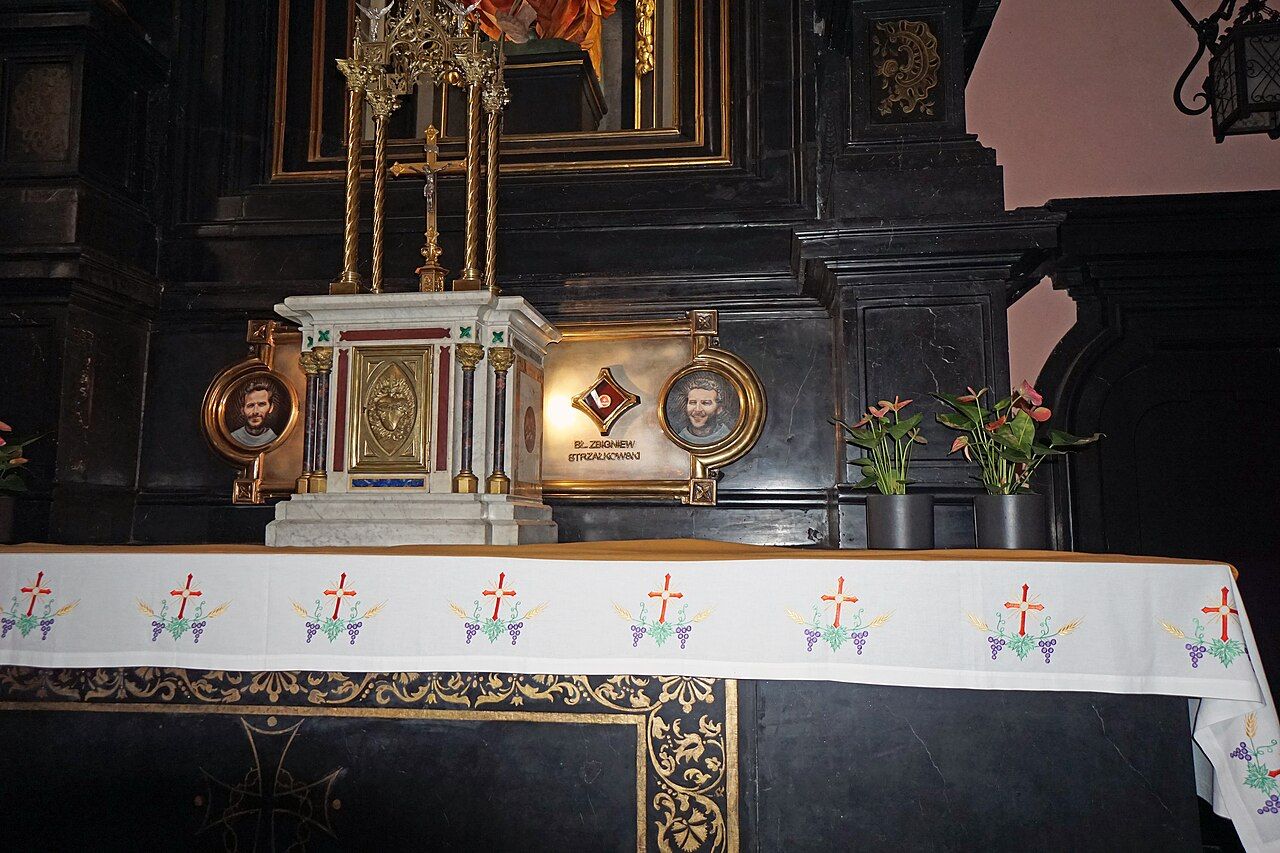
- From Rynek: 5 min
- Era: 13th century; around 1900
- Across Franciszkańska Street: the Bishops’ Palace
The words the university's oldest courtyard bring another Kraków landmark into the mind; here, I stay with the joining of church, painted wall and stained glass.
Myth: did Wyspiański make all the art here?
No. The Stations of the Cross in the basilica’s cloister were painted by Józef Mehoffer. That distinction matters. A church shaped by more than one artist is not a single signature writ large; its separate works keep their own names and places. Wyspiański’s flowers and windows belong to the church, but they do not account for every image in it.
The cloister gives the Stations of the Cross their own place within the basilica, and Mehoffer his own part in its artistic story. The work there sits alongside, rather than beneath, the paintings and glass associated with Wyspiański. The church holds both contributions.
Across Franciszkańska Street stands the Bishops’ Palace. Pope John Paul II spoke to crowds from its so-called papal window at Franciszkańska 3. The basilica and palace face one another across the street, and their stories sit close together without becoming the same story.
For me, this is the quiet pleasure of the place: the medieval beginning does not disappear when the Art Nouveau decoration arrives. The fire, the painted plants, the west window and Mehoffer’s cloister paintings remain different strands, held within one basilica.
More from Old Town and beyond
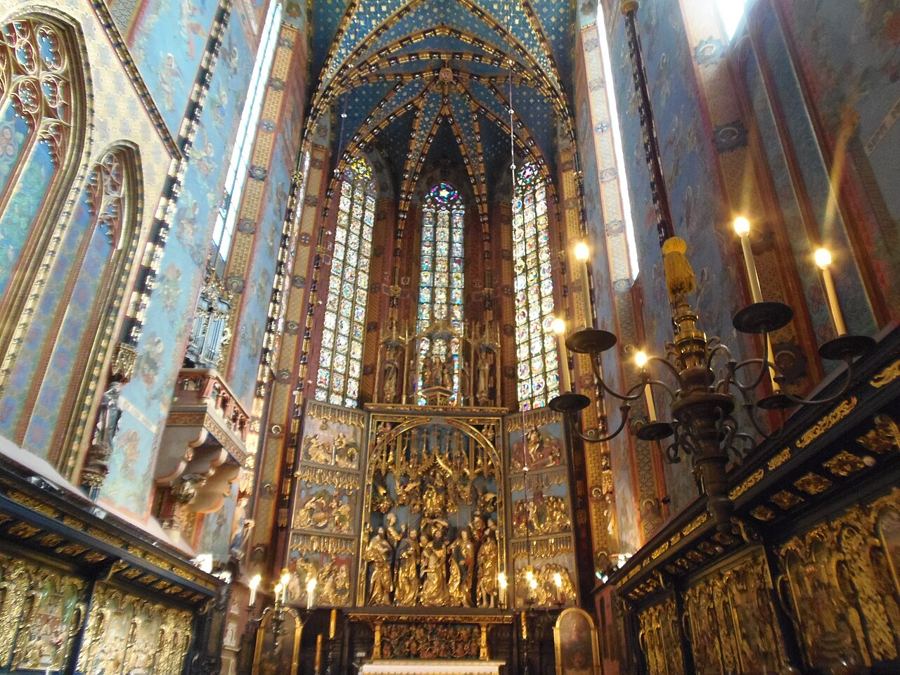 Churches and the bugleWhat happened to Veit Stoss’s altar at St Mary’s Basilica?
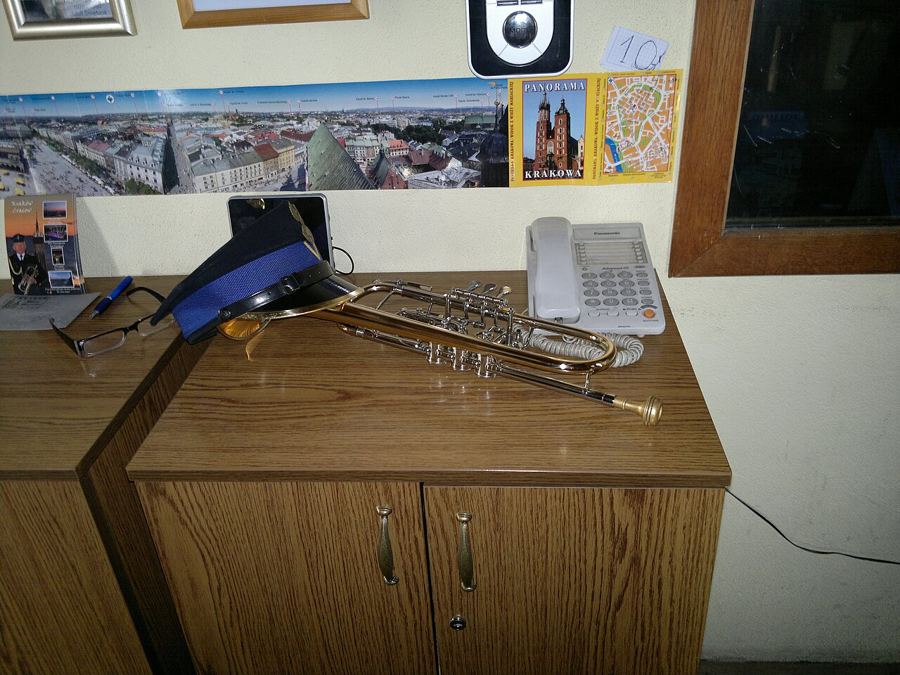 Churches and the bugleThe trumpet call that stops mid-note
 Churches and the bugleTwelve apostles on Grodzka Street
 The Main SquareHow was Rynek Główny measured out in 1257?
 The Main SquareThe Sukiennice: two lives under one roofThe Main SquareBeneath the square: the Rynek Underground
Photographs used: Mielon — Creative Commons BY-SA 3.0; Mark Healey from Brough, UK — Creative Commons BY-SA 2.0; Piotrek Przyborowski — Creative Commons BY-SA 4.0; Igor123121 — Creative Commons BY-SA 4.0; Jakub Hałun — Creative Commons BY-SA 4.0